

|
Your child attends one of the best schools in Dubai. You’ve given them everything — the tutors, the enrichment activities, the opportunities you never had. So why does it feel like they’re slowly falling apart? |
This Isn’t Global Teen Anxiety. This Is Something Specific.
Every Western city has a teen mental health conversation. But the UAE context is different in ways that matter clinically — and that most standard resources completely miss.
British school teens in the UAE show some of the worst wellbeing outcomes of any expatriate population studied. A 2023 PMC research review confirmed what many Dubai parents quietly suspect: the combination of elite academic pressure, cultural displacement, high parental ambition, and a hyper-competitive peer environment creates a stress profile that is genuinely distinct from teenagers in equivalent schools back home.
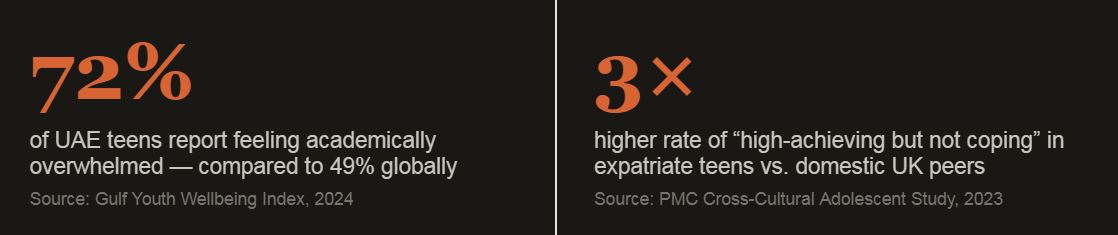
These aren’t abstract statistics. They are your teenager’s daily reality — and most of them have learned to hide it extraordinarily well.
What Burnout Actually Looks Like in a High-Achiever
Burnout in teenagers is consistently misidentified – even by the teenagers themselves. Because the cultural script around ambition tells them that exhaustion equals effort, and effort equals virtue, they reframe their symptoms as proof they’re working hard enough.
Clinicians call this the “high-achieving but not coping” profile. From the outside, everything looks fine – grades are maintained, activities continue, social life appears normal. From the inside, something fundamental has broken.
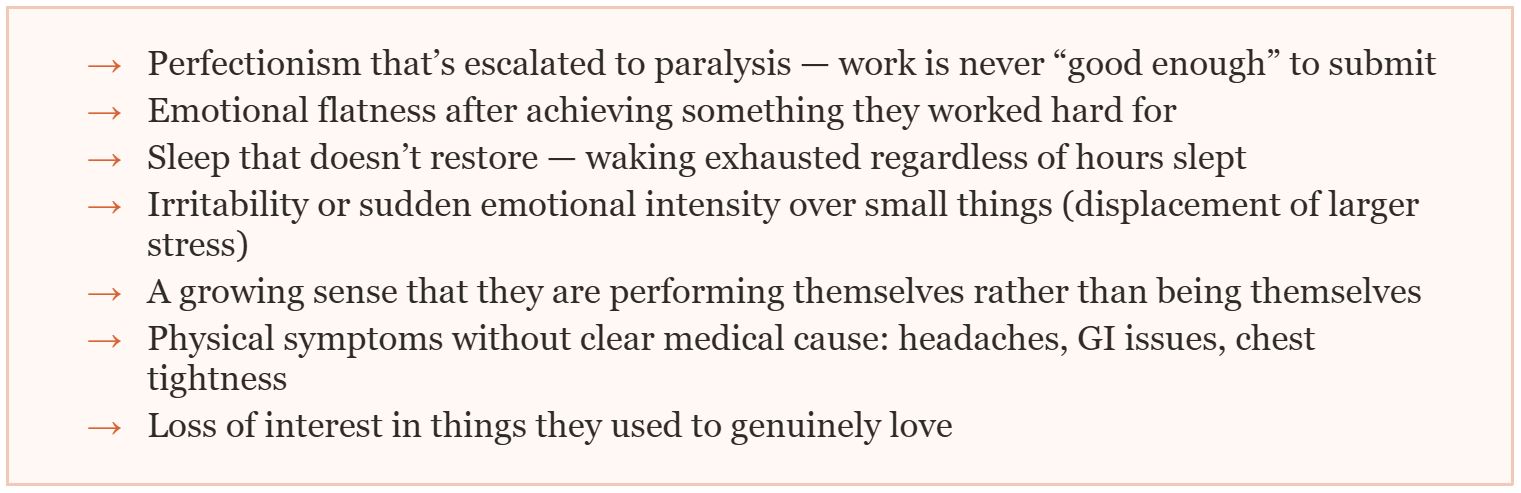

Why Dubai Makes This Harder – and What’s Underneath It
There are structural features of expatriate life in the UAE that compound normal adolescent stress in ways that are rarely acknowledged honestly.
Transience and identity. Many Dubai teenagers have lived in three or four countries. They have learned to form surface-level connections quickly, protect themselves emotionally, and present a consistent, high-functioning face to the world. This is an adaptive strategy — and it is deeply exhausting to maintain for years.
Absent comparison baseline. When your peer group is entirely made up of children of high-achieving expatriates, “normal” becomes radically distorted. A teenager who would be considered exceptionally successful in any other context experiences themselves as average. The psychological toll of this is underestimated by parents and schools alike.
High stakes, compressed timeline. University applications, A-levels, predicted grades — the window in which everything “counts” feels impossibly narrow. In the UAE, with its mix of UK, US, and IB systems, teenagers are often navigating multiple simultaneous academic pressures with no clear sense of which one matters most.
5 Strategies Parents Can Implement Today
1. Separate effort from outcome in every conversation
When you ask about results first, you teach your child that results are what matters to you. Try asking about the process: “What was hard about that? What did you figure out?” This is not soft — it is neurologically how mastery and resilience are built.
2. Name the environment, not the child
When your teenager is struggling, the single most powerful phrase a parent can offer is: “This environment is genuinely hard. The pressure here is real. You are not failing – you are responding to something real.” Externalising the stress reduces shame, which is the primary barrier to asking for help.
3. Protect non-performance time fiercely
Recovery requires time that has no output. Not “productive relaxation.” Not revision in a comfortable environment. Time that produces nothing and is not optimised. Protect one evening a week that belongs entirely to your teenager with no agenda attached to it.
4. Watch for the emotional flatness more than the grades
The early warning sign is not academic decline — it is affective numbing. If your teenager no longer seems to feel much about things they used to care about, that is a clinical signal worth taking seriously before the grades move.
5. Normalise professional support before crisis
In the UAE expatriate community, mental health support is still — quietly — treated as a last resort. The families who fare best are those who build it into ordinary life: a psychologist is someone you see when you’re functioning well, to keep functioning well. Not only when things have broken down.
When Support Changes the Outcome
There is a meaningful difference between a teenager who learns to manage pressure alone — developing brittle, performance-dependent self-esteem — and one who learns to understand themselves well enough to navigate pressure without losing themselves in it.
That second path is learnable. It is not about removing challenge or lowering ambition. The young people we see at Bright Fox who do best academically and personally are not the ones who were protected from difficulty — they are the ones who were given the tools to process it.
Professional support bridges the gap between knowing your child is struggling and knowing what to do about it. Not because parents are failing, but because some conversations need a neutral, skilled space — and teenagers know the difference between a parent who needs them to be okay, and someone who can hold complexity without needing a particular outcome.